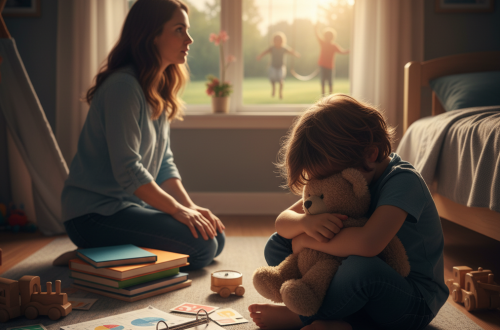
The refusal started early. He would not get in the car. He cried. He said he was tired when he was not. He started inventing alternatives, and the one I remember most is him suggesting, brightly, that we go to the park instead, on an afternoon he knew perfectly well was an ABA afternoon.
I read all of that as behaviour to be managed. It took me a long time to read it as information.
The thing that finally landed
Months later, we found an occupational therapist. I told my son we were going to see someone new.
He cried. He was frightened, and he stayed frightened, because he assumed it would be the same as ABA. He did not calm down until he had been there and understood it was something else.
That is the moment I think about most. Whatever else those hours had accomplished, they had taught my child that a room with an adult and some toys in it is a place where things are done to you. That fear did not stay behind at the old clinic. He carried it into the next place, and the new provider had to spend the first stretch of our time paying it off before any actual work could start.
No progress report I ever received had a line for that.
Distress is not a side effect of the measurement problem
There is a version of this story where the clinic simply was not looking at the right outcomes. I used to believe that version. I no longer do.
When I raised his distress, I was told it was normal, and then asked to request more hours from the insurance company because he needed it. The distress was not invisible to them. It was visible and it was interpreted as evidence that he needed more of what was distressing him.
The wider research at least suggests this is not only our clinic. The 2023 BMJ review known as Project AIM, covering 252 studies and 13,304 children, states that adverse events across this literature were “poorly monitored, but possibly common.” Its authors go on to say that the potential benefits of these interventions cannot be weighed against the potential for adverse effects, because the monitoring and reporting were inadequate.
Read that carefully. It is not a finding that these approaches cause harm. It is a finding that the field has not been systematically checking. Those are different claims, and the second one is the one that mattered to me, because it meant the absence of documented harm in my son’s file told me nothing at all.
What the research on autistic adults adds
I came to this literature late and I want to be careful with it, because it concerns adults and my son was small.
In 2020, Raymaker and colleagues published a study in Autism in Adulthood defining autistic burnout as a syndrome arising from chronic life stress and a mismatch between expectations and abilities without adequate support. They describe long-term exhaustion, loss of skills the person previously had, and reduced tolerance for sensory input. Participants identified masking, meaning the suppression of autistic traits in order to appear less autistic, as a primary contributor. Recovery was associated with acceptance from others, reduced demands, and being allowed to stop masking.
That is not a study about children in therapy and it does not diagnose anything about my son. But it gave me a framework I did not have: that holding it together in one setting can be a cost being paid rather than a skill being demonstrated, and that the bill comes due somewhere else.
Once I had that idea, the pattern in our house made sense. He was fine in the room. He was not fine afterwards. I had been treating the first fact as the result and the second as a separate problem.
What I would watch for now
None of these is proof on its own. Together they are a pattern worth taking seriously.
- Refusal that is getting stronger over time rather than settling, particularly after the first few weeks.
- Distress that starts before the session, in the car or the night before, rather than during it.
- Your child stopping something they used to enjoy.
- Skills or capacities going backwards at home while the reports go forwards.
- Fear that transfers to new settings or new people who have done nothing to earn it.
- A provider whose only response to any of the above is more hours.
What safe looked like, for comparison
With the OT, the first thing they did was let him play with a range of toys and games and watch what he was drawn to. They explained everything to me. They treated the whole family as part of the picture rather than treating my son as the unit of work.
He wanted to come back the next day and did not want to wait a week.
I am not claiming a transformation. Within about four weeks I saw more confidence, better impulse control, and one afternoon he invited another child to play with him. Modest, and real, and more than I had seen in many hours of the other thing.
The variable that mattered was not the discipline. It was that the sessions started from what he was interested in rather than from what he was supposed to comply with, and that when something was not working, changing it was an available option.
If this is your house right now
You are not overreacting, and you are not failing to understand the data. A child who is distressed by the thing that is supposed to be helping is telling you something real, in the only way available to him.
You do not have to make a decision today. You can start by writing down what the fortnight actually looks like at home, sleep and eating and refusal and what he does with his afternoons, and taking that to the next meeting. Clinic data covers the clinic. You are the only person collecting the rest of it.
And if you want a specific question to ask, ask what would change if you reported that your child was distressed. The answer tells you what the model is capable of doing.