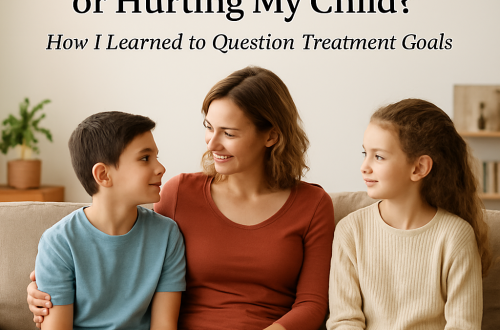
I wish someone had told me this sooner. Our family was funneled into ABA. It happened after a quick appointment and an even quicker insurance approval. The clinic promised social skills. What we got were drills for eye contact, scripts for greetings, and charts of points. My child looked fine in the room. At home, they were tight, quiet, and done. The only fix offered was more hours.
This is the hard lesson I paid for with time and tears. Insurance often favors ABA. It is easy to authorize. This bias kept real help out of reach for us. What our family truly needed was simple and human. We needed communication that worked in daily life. We also needed a body that felt safe. Speech Therapy and Occupational Therapy finally gave us that.
“I can play when I can tell you what I need.”
Finding True Support for Your Child
Our Speech-Language Pathologist kept every door to language open for us. Spoken words, signs, pictures, and AAC were welcome from minute one. She modeled a few words, then waited patiently. She treated a protest like “no” as valuable, not rude. This showed respect for my child’s voice. Our Occupational Therapist changed the space first. This meant softer light and fewer voices. We added movement or deep pressure before any talking. When my child could say “stop,” “help,” or “not now” in any way, social moments started to breathe. This was true social growth.
Quick fact: Speech-Language Pathologists treat social communication skills. This includes spoken language and AAC, turn taking, and conversation rules (American Speech-Language-Hearing Association).
What actually opened the door to real social growth was not more practice of fake hellos. It was consent, choice, and communication. These are tools your child can use anywhere. They are not just for a clinic chair.
Practical Steps for Your Family
- Protect communication first. Keep AAC, pictures, and gestures available during play. Model, then pause.
- Regulate the room. Ask OT to adjust light, sound, seating, and movement before goals begin.
- Start tiny. Try one peer, a short time, and a shared interest. Leave while it still feels good.
- Teach simple self-advocacy. Practice “too loud,” “need space,” and “your turn, then mine.”
- Use home data. Track sleep, appetite, mood, and willingness to return for 24 hours.
- Name the bias. Ask your doctor in writing what mix of OT and Speech they would choose if coverage were equal. Get it in the chart.
If your child has trouble staying focused in therapy, ask to dim the lights. Cut background chatter. Add a brief movement or deep pressure break before any task. If your child goes silent when greeted, stand side by side. Look at a shared toy. Model a short invite on AAC or with two words. Then wait for their response. If playdates keep crashing, move them outdoors. Keep them short. Use headphones and have a clear exit plan.
It can feel overwhelming to question the default path. Please know you are not alone. An insurer’s fast yes led us to a plan that did not fit our family. True communication opened everything. Once your child can say yes, no, and not yet without fear, authentic social growth follows. It happens on their own timeline. That is the door worth walking through.